

Income Tax Act 1961 · Applicable for AY 2026-27 · By ASAS & Associates / KarSahi
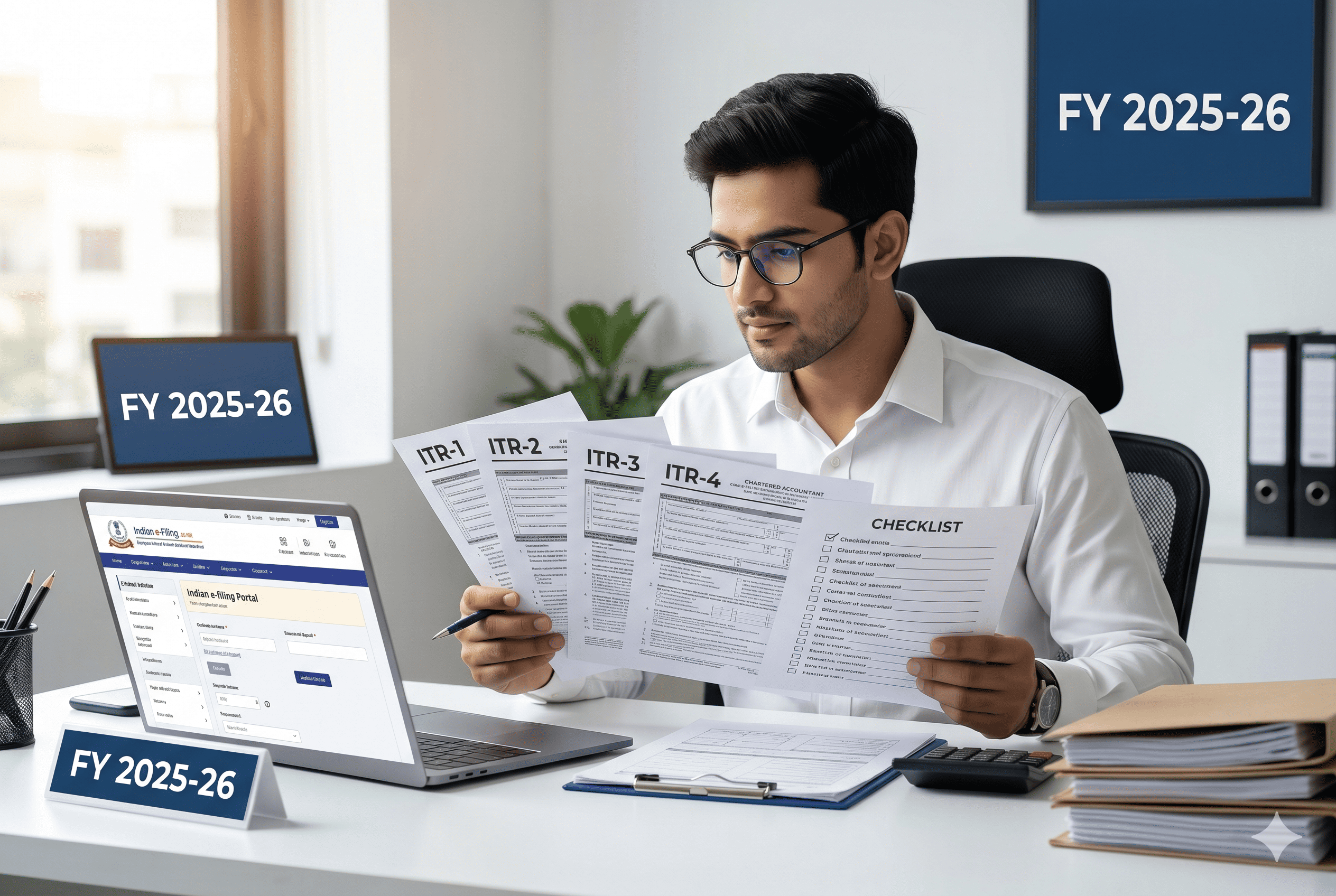
Every year, millions of taxpayers make one avoidable mistake — they file their income tax return using the wrong form. Under Section 139(9) of the Income Tax Act, a return filed in an incorrect form is treated as defective, triggering notices from the Income Tax Department. Getting served a notice is stressful, time-consuming, and entirely preventable. This guide will help you identify exactly which ITR form applies to your income situation.
Why the Form Matters
The Income Tax Department has designed different forms for different types of taxpayers. Each form captures specific income details, deductions, and disclosures relevant to a category of taxpayer. Using the wrong form means either under-reporting your income inadvertently or failing to disclose required information — both of which attract scrutiny.
ITR-1 (Sahaj) — The Simplest Form
ITR-1 is designed for resident individuals whose total income does not exceed ₹50 lakh in a financial year. It covers income from salary, income from one house property, interest income (savings accounts, FDs, NSC), family pension, and agricultural income up to ₹5,000.
You cannot use ITR-1 if you have capital gains of any kind, income from more than one house property, income from business or profession, foreign income or foreign assets, or if you are a director in a company or have invested in unlisted equity shares. NRIs also cannot use ITR-1.
ITR-2 — For Individuals and HUFs Without Business Income
ITR-2 is the appropriate form for individuals and Hindu Undivided Families (HUFs) who have income beyond the scope of ITR-1 but do not run a business or profession. This includes people with capital gains from stocks, mutual funds, or property; income from more than one house property; foreign income or foreign assets; and NRIs with Indian income. ITR-2 is also used when your total income exceeds ₹50 lakh.
The key distinction is that ITR-2 does not allow you to report business or professional income. If you have any income from a business, trade, or profession — even a side consultancy or freelance project — you must move to ITR-3 or ITR-4.
ITR-3 — For Business and Professional Income With Regular Books
ITR-3 covers all income that ITR-2 covers, plus income from business or profession where you maintain regular books of accounts. This is the most comprehensive individual ITR form and applies to sole proprietors, professionals like doctors and lawyers who do not opt for the presumptive scheme, and individuals with F&O trading income (which is treated as business income, not capital gains).
ITR-3 requires you to submit a balance sheet and profit and loss account. If your turnover crosses ₹1 crore (or ₹10 crore if 95% of transactions are digital), a tax audit under Section 44AB is also mandatory.
ITR-4 (Sugam) — For Presumptive Income Declarants
ITR-4 is specifically for individuals, HUFs, and firms (excluding LLPs) who opt for presumptive taxation under Sections 44AD, 44ADA, or 44AE. Under these provisions, you declare a fixed percentage of your turnover or receipts as income without needing to maintain detailed books of accounts.
You can use ITR-4 only if your total income does not exceed ₹50 lakh and you do not have capital gains, foreign income, or foreign assets. Once your turnover crosses the presumptive scheme threshold — ₹3 crore for businesses and ₹75 lakh for professionals — you must switch to ITR-3.
ITR-5, ITR-6, and ITR-7 — Entity-Level Returns
ITR-5 is for firms, LLPs, Association of Persons (AOPs), and Body of Individuals (BOIs). ITR-6 is for companies that are not claiming exemption under Section 11 (charitable or religious trusts). ITR-7 is for entities like trusts, political parties, and research institutions filing under special provisions.
Due Dates You Must Know for AY 2026-27
For individuals and HUFs not requiring a tax audit, the due date for filing is 31st July 2026. If your accounts are subject to a tax audit under Section 44AB, the deadline extends to 31st October 2026. Cases involving transfer pricing audits under Section 92E have a deadline of 30th November 2026. A belated return (filed after the original due date) and a revised return can both be filed up to 31st December 2026.
Penalties and Consequences of Late or Incorrect Filing
If you file after 31st July 2026 and your total income is up to ₹5 lakh, a late fee of ₹1,000 is payable under Section 234F. If your income exceeds ₹5 lakh, the late fee increases to ₹5,000. Beyond the monetary penalty, filing late means losses cannot be carried forward to future years — except for house property losses. Interest under Sections 234A, 234B, and 234C accrues on any unpaid tax liability at 1% per month.
Not filing at all when you have taxable income can result in a penalty of up to ₹10,000 under Section 271F and even prosecution under Section 276CC in serious cases.
Most Common Mistakes That Lead to Defective Returns
Filing ITR-1 when you have even a single rupee of capital gain is one of the most frequently seen errors. Similarly, filing ITR-4 when your turnover exceeds the prescribed threshold invalidates your return. Failing to disclose foreign bank accounts or investments in foreign companies in your ITR is another common oversight that can lead to serious consequences under the Black Money Act. Always reconcile your income with your AIS (Annual Information Statement) and Form 26AS before filing.
KarSahi tip: Our CA reviews your AIS, TIS, and Form 26AS before every filing session to ensure zero mismatches and the correct ITR form is used. Book a slot at karsahi.com.